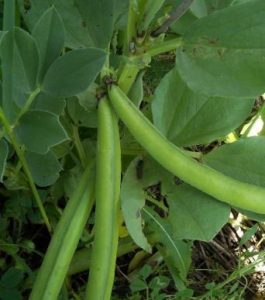
 Common Name: Favabean
Description
Vicia faba, also known as the broad bean, fava bean, faba bean, field bean, bell bean, English bean, horse bean, Windsor bean, pigeon bean and tic(k) bean, is a species of flowering plant in the vetch and pea family Fabaceae. The origin of this legume is obscure, but it had been cultivated in the Middle East for 8,000 years before it spread to Western Europe. Fava or Broad beans have been found in the earliest human settlements. Remains are reported to have been found in Egyptian tombs.[citation needed] They probably originated in the Near East during the Neolithic Age and by the Bronze Age had spread to Northern Italy. They have been found in lakeside settlements in Switzerland and in Britain at Glastonbury. In Egypt, the beans were considered commoner food and were shunned by the upper classes. Fava beans were cultivated by the Egyptians, Greeks and Romans. In ancient Rome, they were used in funeral rites. Pythagoras forbade the eating of fava beans because they contained the souls of the dead. This once forbidden . . . . .Read more
References
Switchboard
Wikipedia
Selected Species
- Allanblackia floribunda
- Dacryodes edulis
- Irvingia gabonensis
- Moringa oleifera
- Ricinodendron heudelotii
- Sclerocarya birrea
- Tamarindus indica
- Uapaca kirkiana
- Vitellaria paradoxa
- Vitex doniana
- Ziziphus mauritiana
- Anacardium occidentale
- Annona senegalensis.
- Annona reticulata
- Artocarpus heterophyllus
- Balanites aegyptiaca
- Canarium madagascariense
- Carica papaya
- Carissa spinarum
- Casimiroa edulis
- Cocos nucifera
- Detarium senegalense
- Diospyros mespiliformis
- Dovyalis caffra
- Faidherbia albida
- Garcinia livingstonii
- Garcinia mangostana
- Gnetum africanum
- Hibiscus sabdariffa
- Mangifera indica
- Morus alba
- Opuntia monacantha
- Parinari curatellifolia
- Persea americana
- Psidium guajava
- Saba comorensis
- Strychnos spinosa
- Syzygium guineense
- Parkia biglobosa
- Adansonia digitata
- Ximenia caffra
- Ensete ventricosum
- Lablab purpureus
- Lens culinaris
- Macrotyloma geocarpum
- Momordica charantia
- Musa acuminata AAA Group
- Musa balbisiana
- Phaseolus vulgaris
- Plectranthus esculentus
- Plectranthus rotundifolius
- Solanum nigrum
- Talinum fruticosum
- Tylosema esculentum
- Vangueria madagascariensis
- Vangueria infausta
- Vicia faba
- Vigna radiata
- Vigna subterranea
- Xanthosoma sagittifolium
- Abelmoschus caillei
- Amaranthus tricolor
- Basella alba
- Brassica carinata
- Cassia obtusifolia
- Celosia argentea
- Citrullus lanatus
- Cleome gynandra
- Colocasia esculenta
- Corchorus olitorius
- Crassocephalum rubens
- Crotalaria juncea
- Cucumis metuliferus
- Cucurbita maxima
- Cyphomandra betacea
- Digitaria exilis
- Dioscorea alata
- Dioscorea rotundata
- Eleusine coracana
- Allium cepa
- Ipomoea batatas
- Passiflora edulis
- Solanum aethiopicum
- Sphenostylis stenocarpa
- Telfairia occidentalis
- Xanthosoma spp
- Amaranthus cruentus
- Boscia senegalensis
- Chrysophyllum cainito
- Plant Breeding Academy: boosting Africa’s food supply with improved indigenous crops
- Africa’s Indigenous Fruit Trees: A Blessing in Decline
- Transforming food
- New partnership
- How a consortium is changing Africa’s food systems.
- UC Davis African Plant Breeding Academy starts the second class
- Fighting malnutrition in Africa with improved traditional plants
- An Ambitious Genome Sequencing Project Is Tackling Africa’s Nutrition Crisis
- Use of microsatellite markers for the assessment of bambara groundnut breeding system and varietal purity before genome sequencing
- LGC publishes new guide on practical laboratory skills for molecular biologists
- UC Davis partners with African Orphan Crops Consortium to sequence genomes of 101 indigenous African foods
- Forgotten Crops May Hold Key to Nutritional Security
- Forest people of DR Congo guide orphan crop research
- Indigenous African crops meet state of the art plant breeding
- Promoting early-maturing, oil-rich shea trees and holding off the charcoal threat
- How Happiness is breeding plants for Africa’s future
- Artocarpus altilis
- Icacina oliviformis
- Landolphia spp
- Lannea microcarpa
- Macadamia ternifolia
- Pistacia vera
- Dioscorea dumetorum
- Solanum scabrum
- Sequencing all life captivates biologists
- Promoting neglected and underutilized crop species
- Allanblackia stulhmanii
- Detarium microcarpum
- Eragrostis tef
- Saba senegalensis
- Strychnos cocculoides
- Supporting human nutrition in Africa through the integration of new and orphan crops into food systems: placing the work of the African Orphan Crops Consortium in context
- Breeders’ views on the production of new and orphan crops in Africa: a survey of constraints and opportunities
- Delivering Perennial New and Orphan Crops for Resilient and Nutritious Farming Systems
- MEDIA RELEASE| Enhancing African orphan crops with genomics