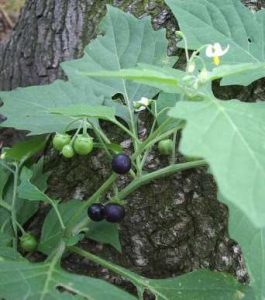
 Common Name: African Nightshade
Description
European black nightshade (Solanum nigrum) or locally just black nightshade, duscle, garden nightshade, garden huckleberry, hound’s berry, petty morel, wonder berry, small-fruited black nightshade, or popolo) is a species in the Solanum genus, native to Eurasia and introduced in the Americas, Australasia, and South Africa. Parts of this plant can be toxic to livestock and humans. Nonetheless, ripe berries and cooked leaves of edible strains are used as food in some locales, and plant parts are used as a traditional medicine. A tendency exists in literature to incorrectly refer to many of the other “black nightshade” species as “Solanum nigrum”.. . . . .Read more
References
Switchboard
Wikipedia
Ongoing
Solanum aethiopicum
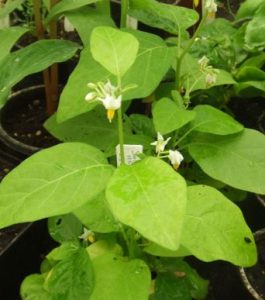 Common Name: African Eggplant
Description
Solanum aethiopicum, the bitter tomato, Ethiopian eggplant , or nakati, is a fruiting plant of the genus Solanum mainly found in Asia and Tropical Africa. It is also known as Ethiopian nightshade, garden eggs, and mock tomato. It is a popular vegetable in north-east India, and is known as khamen akhaba in Manipuri and samtawk in Mizo. These names are a result of its varied morphology, with ripe fruit often looking like a cross between an eggplant and a tomato, which are also from Solanum. In fact, the Ethiopian eggplant was so much confused with the ordinary eggplant that t . . . . .Read more
References
Switchboard
Wikipedia
Irvingia gabonensis
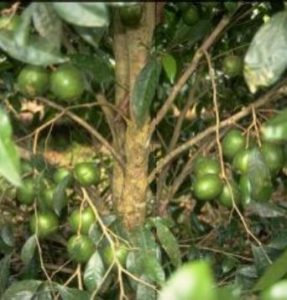 Common Name:African bush mango
Description
Irvingia gabonensis grows to a height of 15-40 m, bole slightly buttressed. It has a dense, compact crown, branchlets ending in a narrow, curved, stipular sheath covering the leaf bud. Bark greyish, smooth or very slightly scaly; slash yellowish-brown to light yellow, brittle.
Leaves 5-15 x 2.5-6 cm, elliptic to slightly obovate, 1 margin often a little more rounded than the other, acute or shortly acuminate, cuneate or slightly rounded at the base; leathery dark green and glossy above; with 5-10 pairs of irregular lateral veins, the lower ones running out nearly to the margin…Read more
References
Switchboard
Wikipedia