 Common Name:Papaya
Descripition
Carica papaya is an evergreen, tree-like herb, 2-10 m tall, usually unbranched, although sometimes branched due to injury, containing white latex in all parts. Stem cylindrical, 10-30 cm in diameter, hollow with prominent leaf scars and spongy-fibrous tissue. Has an extensive rooting system.
Leaves spirally arranged, clustered near apex of trunk; petiole up to 1 m long, hollow, greenish or purplish-green; lamina orbicular, 25-75 cm in diameter, palmate, deeply 7-lobed, glabrous, prominently veined; lobes deeply and broadly toothed.Read more
References
Switchboard
Ongoing
Cleome gynandra
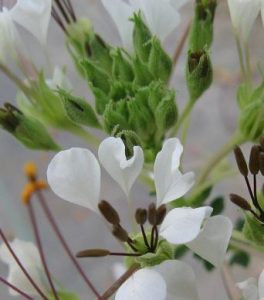 Common Name: Spiderplant
Description
Cleome gynandra is a species of Cleome that is used as a green vegetable. It is known by many common names including Shona cabbage[, African cabbage, spiderwisp, cat’s whiskers,and stinkweed. It is an annual wildflower native to Africa but has become widespread in many tropical and sub-tropical parts of the world. It is an erect, branching plant generally between 25 cm and 60 cm tall. Its sparse leaves are each made up of 3-5 oval-shaped leaflets. The flowers are white, sometimes changing to rose pink as they age. The seed is a brown 1.5mm diameter sphere. The leaves are edible. . . . .Read more
References
Switchboard
Wikipedia
Morus alba
 Common Name:Mulberry
Description
Morus alba is a fast-growing shrub or moderate-sized tree with a fairly cylindrical, straight bole, up to 35 m high and 1.8 m in girth, without buttresses; bark dark greyish-brown, rough with vertical fissures; exuding white or yellowish-white latex.
Leaves very variable, ovate or broadly ovate, distichous, simple to 3-lobed, dentate, palmately 3-veined at base; stipules lateral, caducous, coriaceous.Read more
References
Switchboard
Wikipedia