 Common Name: Cape tomato
Description
Cyphomandra betacea is a semi-woody shrub or small tree 2-3 m high, rarely 5 m. It is unarmed, pubescent, with a short trunk and stout lateral branches. The bark is grey.
Leaves alternate, simple, entire, usually grouped at the branch tips, with a robust petiole, 4-8 cm long. The limb is large, 15-30 x 10-20 cm, ovate, shortly acuminate, with a cordate base. Young leaves covered on both surfaces with a soft pubescence; with age, the upper surface becomes glabrous. Midrib and principal veins prominent on both surfaces. . . . .Read more
References
ICRAF Switchboard
Wikipedia
Annuals
Vangueria madagascariensis
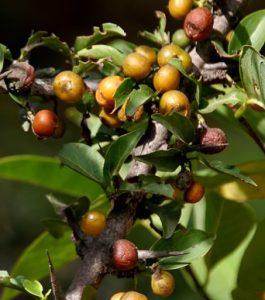 Common Name: African Medlars
Description
Vangueria madagascariensis is a profusely branched shrub or small tree, 2-15 m tall, with smooth grey bark and a whitish or cream slash.
Leaves opposite, elliptic-ovate or rotundate, dark green above, paler beneath, glabrous or, rarely, slightly pubescent, with acuminate or, rarely. . . .Read more
References
ICRAF Switchboard
Wikipedia
Amaranthus tricolor
 Common Name: Vegetable amaranth
Description
Amaranthus tricolor is an ornamental plant known as tampala, tandaljo or tandalja bhaji in India,[3] callaloo in the Caribbean and Joseph’s coat after the Biblical figure Joseph, who is said to have worn a coat of many colors. Although it is native to South America, many varieties of amaranth can be found across the world in a myriad of different climates due to it being a C4 carbon fixation plant, which allows it to convert carbon dioxide into biomass at an extremely efficient rate when compared to other plants. Cultivars have striking yellow, red and green foliage. . . . .Read more
References
Switchboard
Wikipedia
Dioscorea rotundata
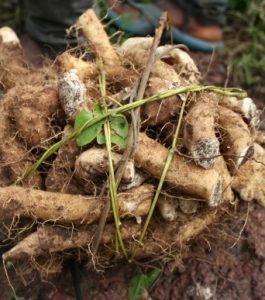 Common Name: Yams
Description
Yam is the common name for some plant species in the genus Dioscorea (family Dioscoreaceae) that form edible tubers.
These are perennial herbaceous vines cultivated for the consumption of their starchy tubers in Africa, Asia, Latin America, the Caribbean and Oceania. There are many cultivars of yam. Although some varieties of sweet potato (Ipomoea batatas) are also called yam in parts of the United States and Canada, sweet potato is not part of the family Dioscoreaceae but belongs in the unrelated morning glory family Convolvulaceae. . . . .Read more
References
Switchboard
Wikipedia