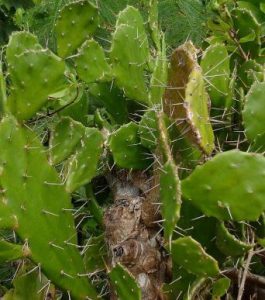
 Common Name:Prickly pear
Description
Opuntia monacantha, commonly known as drooping prickly pear, cochineal prickly pear, or Barbary fig, is a species of plant in the Cactaceae family. It is native to Argentina, Brazil, Paraguay, and Uruguay and is naturalised in Australia and South Africa. Its natural habitats are subtropical or tropical moist lowland forests and sandy shores.
The species was first formally described in 1812 by botanist Adrian Haworth in Synopsis Plantarum Succulentarum. The name Opuntia vulgaris, which is a synonym of Opuntia ficus-indica, has been misapplied to this species in Australia.Read more
References
Switchboard
Wikipedia
Meet the crops
Musa balbisiana
 Common Name: Bananas
Description
Musa balbisiana is a species of wild banana native to eastern South Asia, northern Southeast Asia, and southern China. It is one of the ancestors of modern cultivated bananas, along with Musa acuminata. It was first scientifically described in 1820 by the Italian botanist Luigi Aloysius Colla. It grows lush leaves in clumps with a more upright habit than most cultivated bananas. Flowers grow in inflorescences coloured red to maroon. The fruit are between blue and green. They are considered inedible because of the seeds they contain. It may be assumed that wild bananas were cooked and eaten or agriculturalists would not have developed the cultivated banana. Seeded Musa balbisiana fruit are called butuhan (‘with seeds’) in the Philippines, and kluai tani in Thailand. Natural parthenocarpic clones occur through polyploidy and produce edible bananas, examples of which are wild saba bananas. . . . .Read more
References
Switchboard
Wikipedia
Brassica carinata
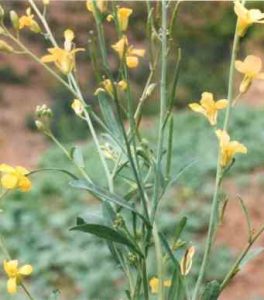 Common Name: Ethiopia Mustard
Description
Brassica carinata (Ethiopian rape,Ethiopian mustard, Abyssinian mustard) is a member of the Triangle of U species (U, 1935) in the agriculturally significant Brassica genus. It has 34 chromosomes with genome composition BBCC, and is thought to result from an ancestral hybridisation event between Brassica nigra (genome composition BB) and Brassica oleracea (genome composition CC) (Prakash and Hinata, 1980). Although B. carinata is cultivated as an oilseed crop in Ethiopia (Alemayehu and Becker, 2004), it has generally high levels of undesirable glucosinolates and erucic acid (Getinet et al. 1997), making it a poor choice for general cultivation as an oilseed crop in comparison to the closely related Brassica napus (Rapeseed) . . . .Read more
References
Switchboard
Wikipedia
Allium cepa
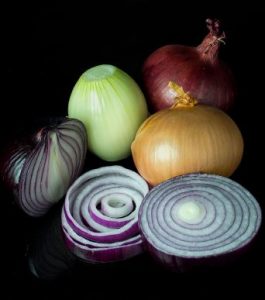 Common Name: Onion
Description
The onion (Allium cepa L., from Latin cepa ‘onion’), also known as the bulb onion or common onion, is a vegetable and is the most widely cultivated species of the genus Allium.This genus also contains several other species variously referred to as onions and cultivated for food, such as the Japanese bunching onion (Allium fistulosum), the tree onion (A. xproliferum), and the Canada onion (Allium canadense). The name “wild onion” is applied to a number of Allium species, but A. cepa is exclusively known from cultivation. Its ancestral wild original form is not known, although . . . . .Read more
References
Switchboard
Wikipedia