Moringa oleifera


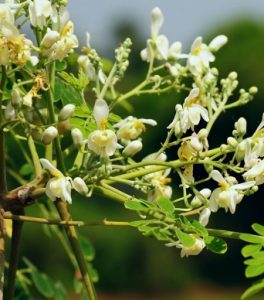
Moringa oleiferaCommon Name:Drum stick

Description
Moringa oleifera is a small, graceful, deciduous tree with sparse foliage, often resembling a leguminous species at a distance, especially when in flower, but immediately recognized when in fruit. The tree grows to 8 m high and 60 cm dbh. Bole crooked, often forked from near the base. Bark smooth, dark grey; slash thin, yellowish. Twigs and shoots shortly but densely hairy. Crown wide, open, typically umbrella shaped and usually a single stem; often deep rooted. The wood is soft.
Leaves alternate, the old ones soon falling off; each leaf large (up to about 90 cm long), with opposite pinnae…Read more
References
Switchboard
Wikipedia

Casimiroa edulis


Casimiroa edulisCommon Name:White sapote
Description
Casimiroa edulis is an evergreen tree to 18 m tall, with spreading, often drooping branches and a broad leafy crown. Bark light-grey, thick and warty.
Leaves palmately compound, alternate, digitate; stipules absent; petiole 5-9.5 cm, finely pubescent; leaflets sessile or subsessile, 3-7, elliptic, ovate or broadly ovate, 4.5-12 cm long, 1-5 cm wide, apex acuminate, retuse or occasionally rounded, base cuneate, margins subserrate, bright green, glabrous or with scattered pubescence on the veins, vennation pinnate, anastomising at the margins. Read more
References
switchboard
Wikipedia

Saba comorensis


Saba comorensisCommon Name:Rubber vines
Description
Saba comorensis is a strong forest liana up to 20 m long on other trees. Stem lenticillate and exuding a white sticky latex when cut.
Leaves ovate or elliptic, base rounded or subcordate, apex obtuse or rounded, 7-16 x 4-8.5 cm, glabrous.Read more
References
Switchboard
Wikipedia

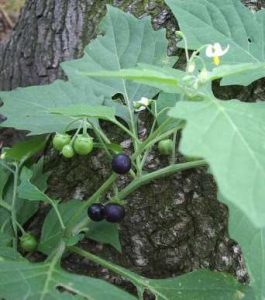
Solanum nigrum


Solanum nigrumCommon Name: African Nightshade
Description
European black nightshade (Solanum nigrum) or locally just black nightshade, duscle, garden nightshade, garden huckleberry, hound’s berry, petty morel, wonder berry, small-fruited black nightshade, or popolo) is a species in the Solanum genus, native to Eurasia and introduced in the Americas, Australasia, and South Africa. Parts of this plant can be toxic to livestock and humans. Nonetheless, ripe berries and cooked leaves of edible strains are used as food in some locales, and plant parts are used as a traditional medicine. A tendency exists in literature to incorrectly refer to many of the other “black nightshade” species as “Solanum nigrum”.. . . . .Read more

References
Switchboard
Wikipedia